Why is Business Continuity management critical to your business?
Business continuity management sounds like a “far from my bed show” to many business owners. Or they prefer not to dwell on it. But if business activities have to stop and no products or services can be delivered, this can have a major impact on your right to exist as an entrepreneur. However, if the risks are identified in time, this can prevent a lot of misery. With an ISO 9001 quality management system, you have a smart way of understanding the potential disruptions to your services.
Importance of continuity
The importance of continuity in a business operation is crucial for organizations that want to operate efficiently now, as well as in the future. Any disruption in business operations is a waste of time and/or resources, but can also reduce delivery reliability to customers. And even lead to significant loss of reputation.
The problems in service settlement at Schiphol Airport due to lack of personnel is an example. But also, for example, a server hostage taking, making business information inaccessible. Organizations must therefore periodically ask themselves whether the risks in current operations are sufficiently covered. Now, but certainly also in the future. Only then can they prepare for unwanted events.
What does Business continuity management consist of?
Business continuity management is based on the general principles of quality management. However, it does approach business operations from a very specific angle, namely the “worst case scenarios.
So business continuity management is planning and thinking about things that are not mundane.
For example, what is the effect of loss of electricity in the factory, do they use very special parts or are they available as standard?
But even the employee who manages your complex Excel files can fall ill for a long time or even leave the organization.
Companies need to keep these critical issues in sight and come up with safeguards where possible.
What is a business continuity plan?
A business continuity plan is an overview of possible scenarios that can seriously disrupt business operations and even bring them to a long-term halt, and the actions required to recover from them. To arrive at this overview, a global brainstorming session about possible risks in the business processes is often organized first. Various techniques are available for this, all of which basically quantitatively assess the known product of probability and effect. Once the risks are known, it is then determined how to combat these risks if the “worst case scenario” does occur unexpectedly.
A practical example of a measure with our workflow management application is to define an RTO and RPO at a second geographic location. Should the first geographic location go down due to an earthquake, for example, we will continue our services from a second data center.
Importance of a Business continuity plan
Having figured out in advance how best to handle it allows for quick and effective action. Of course, the measures must be proportionate to the cost and type of service provided. A website of most companies may well be down for a while. It’s a different story if, for example, this is the web shop that makes the money.
So tailor the business continuity plan for the company. But also make sure it stays up to date.
Especially in the field of IT, this is often thought of too easily. An ISO-27001 certified software or IT supplier is certainly no guarantee, but it is proof that there is a structured focus on information security.
Be prepared
Preparation means ensuring that critical business information is always available to complete business processes or have current insight into the status of various activities. So a good inventory of process flows, information sources and the systems used is a basic requirement.
With LeanForms, you can optimize and standardize lots of business processes, including workflow management and authorization at the person level.
In addition, the information is stored in a central secure location with backup and recovery plans included as standard in the service.
This is why many organizations have incorporated LeanForms into their IT landscape. As a complement to their ERP but also a more secure and effective alternative to the many uncontrolled Excel files.

Want to know more? Get in touch
Do you have questions or are you curious how LeanForms can support your organization? We are ready to answer all your questions! Get instant specialized advice on the best solution for your specific situation.

Related items
MKG & LeanForms Inspiration Afternoon
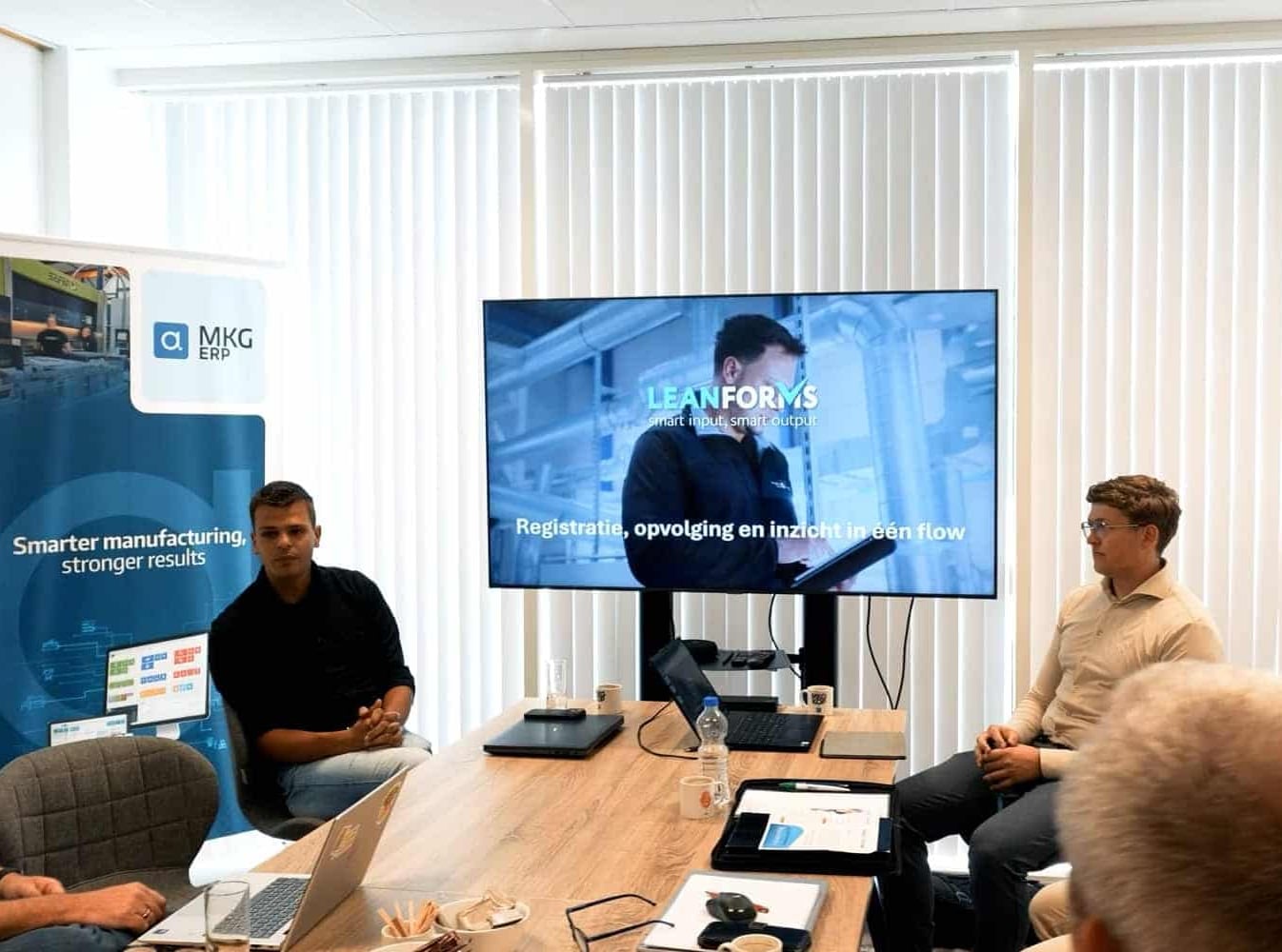
When shop floor data, process knowledge, and systems come together, clarity emerges. This interconnection was the focus of the MKG and LeanForms inspiration afternoon on July 1, 2026. At the Brainport Industries Campus (BIC) in Eindhoven, the discussion centered on how to make information from the field immediately usable within your processes.

What is quality management system?
Quality management is a catch-all term for many business owners. It is seen by managers as a necessary evil to hang the certificate on the wall. A proof of good behavior for the customers. However, if the principles of quality management are properly applied, they contribute daily to more efficient operations. And therefore to the bottom line. This is precisely why every organization can benefit from practical quality management. And surely that makes everyone happy.

Prospective risk analysis, smart execution one less worry!
With a prospective risk analysis, you analyze risks. The power of a good PRI is in its integration with daily activities.

RI&E: What Is It, and How Can You Turn It Into a Dynamic Tool?
An RI&E—which stands for risk inventory and evaluation—identifies the occupational risks within an organization. An action plan allows you to specify which measures are necessary, who is responsible, and when they will be implemented.